Website Builders Versus Custom Development
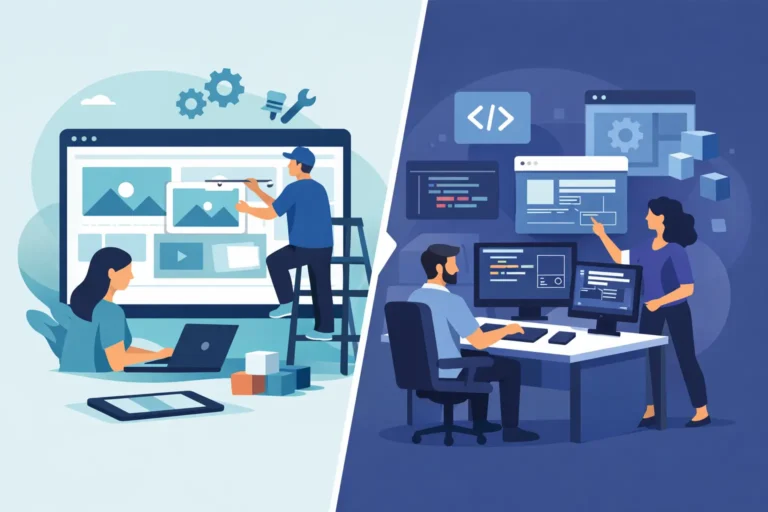
A website launch can look deceptively simple from the outside. Choose a template, add copy and images, connect a domain, and publish. But when the site needs to generate qualified leads, support a sales process, manage commerce, connect to internal systems, or represent an established brand, the decision between website builders versus custom development becomes far more consequential.
Neither option is automatically better. The right choice depends on what your business needs the website to do now, how often it will change, and where growth is likely to create operational pressure later. A practical decision starts with business requirements, not platform preferences.
Website Builders Versus Custom Development: The Core Difference
Website builders provide a structured environment for creating and managing a site. Platforms such as Webflow, WordPress with a visual builder, Shopify, and Framer can accelerate production through templates, prebuilt features, hosted infrastructure, and editor-friendly content tools. They are often an excellent fit when speed, straightforward content management, and predictable budgets matter most.
Custom development is built around the specific requirements of the business. This may include a custom WordPress theme, a tailored Webflow implementation, a headless content system, or a bespoke web application. Rather than adapting operations to fit a platform’s limitations, the site architecture, user flows, integrations, and design system are planned around the organization’s goals.
The distinction is not simply “easy” versus “advanced.” A professionally built website on Webflow or WordPress can be highly customized. Likewise, custom development should not mean building every feature from scratch. The strongest approach uses proven technology where it makes sense and customizes the parts that create meaningful business value.
When a Website Builder Makes Business Sense
A website builder is often the right choice for a startup, local business, campaign site, or company that needs a polished digital presence without complex requirements. It can shorten the path from strategy to launch, especially when the website has a manageable number of pages and a clear conversion goal.
For example, a professional services firm may need a fast, credible site with service pages, case studies, team profiles, an inquiry form, and a simple blog. A well-designed Webflow or WordPress site can meet those needs effectively while allowing internal teams to update content without relying on a developer for every revision.
Website builders can also be valuable when marketing teams need flexibility. If campaigns change frequently, a visual editor can help teams create landing pages, test messaging, publish resources, and keep content current. That autonomy can reduce bottlenecks and improve campaign velocity.
However, the platform still needs disciplined implementation. A template with oversized images, unnecessary plugins, inconsistent styling, or poorly configured forms can create slow loading times and a fragmented user experience. Using a website builder does not remove the need for UX planning, technical QA, mobile optimization, SEO structure, and conversion-focused design.
Builder strengths to consider
Website builders are usually strongest when your priorities are a faster launch, simpler content updates, lower initial complexity, and standard website functionality. They can also provide reliable foundations for small-to-midsize commerce stores, resource libraries, portfolios, and lead-generation sites.
The key question is whether the platform supports your requirements cleanly. If the answer requires multiple workarounds, disconnected tools, or ongoing manual processes, the initial convenience can become expensive over time.
Where Custom Development Creates More Value
Custom development becomes more compelling when the website is central to how the business operates. That could mean a complex product catalog, customer portal, booking workflow, membership experience, multi-location content structure, CRM integration, proprietary calculator, or a web application with distinct user roles.
In these cases, the website is not only a marketing asset. It is part of the business infrastructure. Generic templates and third-party add-ons may cover parts of the requirement, but they can introduce limitations in performance, security, user experience, and long-term maintenance.
A custom build gives your team more control over the experience visitors receive. Navigation can reflect how customers actually evaluate your services. Lead forms can qualify prospects before they reach sales. Commerce workflows can reduce friction at checkout. Backend tools can align with the way your operations team manages data and content.
Performance is another important factor. Custom development makes it easier to avoid excess code, unnecessary scripts, and plugin dependency. That does not guarantee a fast website on its own, but it creates a cleaner foundation for optimization. Faster pages can improve user engagement, support search visibility, and reduce the chance that a high-intent visitor leaves before the page loads.
The Real Cost Is More Than the Initial Build
A website builder often has a lower upfront price, but initial cost should not be the only financial measure. Subscription fees, paid apps, premium plugins, integration tools, redesigns, maintenance, and staff time all affect the long-term cost of ownership.
Custom development requires more investment at the beginning because discovery, UX design, architecture, development, testing, and documentation take time. That investment may be justified when the website reduces manual work, improves conversion rates, supports more revenue, or avoids the need to replace a limited platform within a year or two.
Consider a company that uses separate tools for appointment requests, quote generation, customer data, email routing, and reporting. A low-cost website may appear efficient until staff members spend hours moving data between systems. A custom integration can carry a higher project cost while creating a more reliable process and better visibility into lead performance.
The best decision considers the cost of delay and the cost of compromise. If a basic site can support the next stage of growth, launching on a flexible builder may be smart. If platform limitations will interfere with sales, operations, or customer service from day one, a custom solution may be the more responsible investment.
Scalability Is About Operations, Not Just Traffic
Businesses often associate scalability with traffic volume. Traffic matters, but it is only one part of the picture. A scalable website also supports more content, more products, more team members, more integrations, more markets, and more sophisticated customer journeys without becoming difficult to manage.
A growing company might begin with a five-page marketing site and later need regional landing pages, gated resources, multilingual content, a partner portal, or product comparison tools. Planning for every future possibility is rarely practical. Still, choosing a platform and structure that can evolve prevents costly rework.
This is where a platform-flexible approach is useful. WordPress may be a strong choice for content-heavy organizations that need editorial control. Webflow can work well for marketing-led teams that value visual flexibility and clean publishing workflows. Framer can be an efficient option for focused, design-forward websites. A bespoke application may be necessary when business logic, data models, or workflows go beyond the strengths of a traditional CMS.
The platform should serve the operating model, not dictate it.
Questions to Ask Before Choosing
Before committing to a website builder or custom development path, leadership teams should clarify a few practical issues. What action should visitors take, and what prevents them from taking it today? Who will own content updates after launch? Which systems must the site connect to? How much customization is truly required for the user experience? What will the business need from the site in 12 to 24 months?
It is also worth examining internal capacity. A platform with an easy editor is useful only if someone has the time and process to maintain content quality. A custom system can provide powerful capabilities, but it should be supported by clear documentation and a dependable maintenance plan.
At ZOMPIT, the goal is not to push every business toward one technology. It is to build a website that supports measurable growth, from a conversion-focused marketing site to a more complex digital experience with tailored functionality.
Choose the Path That Removes Friction
The right website is the one that makes it easier for customers to understand your value, take the next step, and stay engaged with your business. For some teams, that means launching quickly on a well-built platform. For others, it means investing in custom architecture that supports a more demanding operation.
Start with the friction your business needs to remove. A clear answer will point you toward the technology, process, and level of customization that can keep working long after launch day.