CMS vs DXP: Which Platform Fits Your Business?
A marketing team needs to publish a campaign page by Friday. A sales team wants that page connected to its CRM. Customers expect relevant offers across web, email, and mobile. The CMS vs DXP decision starts with a practical question: do you need a better way to manage a website, or do you need a connected system for managing the broader customer experience?
The answer affects more than software licensing. It shapes your content workflow, integration requirements, internal ownership, launch timeline, and long-term cost. For many businesses, a well-planned CMS is the right foundation. For others, a DXP becomes worthwhile when digital operations span multiple channels, teams, and customer data sources.
What Is a CMS?
A content management system, or CMS, helps nontechnical users create, organize, update, and publish website content without editing code for every change. Pages, blog posts, landing pages, media, product information, and SEO fields can be managed through an administrative interface.
WordPress, Webflow, and other modern CMS platforms can support polished marketing sites, ecommerce experiences, resource centers, and campaign landing pages. With the right design and development approach, a CMS can also connect to forms, booking tools, payment systems, CRMs, analytics platforms, and custom applications.
For a growing business, the central value is control. Your marketing or operations team can keep content current, launch new pages faster, and reduce dependency on a developer for routine updates. A CMS is often the most efficient choice when your primary digital goal is to operate a high-performing website that generates leads, supports sales, or publishes content consistently.
That does not mean every CMS implementation is simple. A poorly structured CMS can create slow pages, inconsistent layouts, fragile plugins, and difficult publishing workflows. The platform matters, but the information architecture, component system, hosting setup, integrations, and ongoing maintenance matter just as much.
What Is a DXP?
A digital experience platform, or DXP, is a broader platform designed to coordinate personalized digital experiences across multiple channels. It may include content management, customer profiles, audience segmentation, workflow management, analytics, commerce capabilities, marketing tools, and integrations with systems such as a CRM, customer data platform, or product database.
A DXP is built for organizations that need to deliver coordinated experiences beyond one website. For example, a financial services company may need different content, offers, and journeys for prospective customers, existing clients, and advisors across a website, portal, mobile app, and email program. A DXP can help centralize rules, data, content, and governance for that scale.
The distinction is not always clean. Many CMS platforms now offer personalization features, ecommerce extensions, automation connections, and headless delivery. Likewise, some DXPs use a CMS as one part of their architecture. The more useful comparison is not a feature checklist. It is whether your business has the operational maturity and customer-experience complexity to benefit from a larger platform.
CMS vs DXP: The Business Differences That Matter
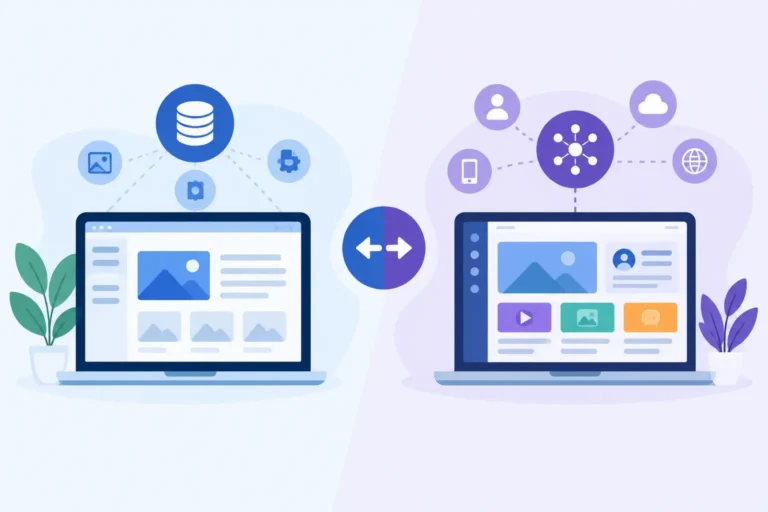
A CMS is usually website-centered. It gives your team a practical environment to manage pages and content, then extends through integrations as needed. A DXP is experience-centered. It aims to coordinate content, data, personalization, and workflows across a larger ecosystem.
Content publishing and team ownership
A CMS is typically easier to adopt for marketing teams. Editors can draft a page, approve it, schedule publication, and make updates with relatively light training. This is particularly valuable for companies that need frequent campaign changes without adding technical bottlenecks.
A DXP may provide more advanced governance, permissions, approval paths, and content reuse across regions, brands, or channels. Those capabilities are valuable for larger teams, but they also require clearer processes. If your business does not have dedicated owners for content operations, data, and platform administration, a sophisticated DXP can become underused.
Personalization and customer data
Most businesses do not need one-to-one website personalization on day one. They need clear messaging, strong page speed, intuitive navigation, reliable forms, and a conversion path that makes sense for real buyers. A CMS can support these fundamentals very effectively.
A DXP makes more sense when personalization depends on meaningful data and repeatable segments. Perhaps visitors need different content based on industry, account status, location, purchase history, or relationship stage. In that case, the platform must reliably connect to the systems that hold that information.
Personalization is only as useful as the data behind it. If CRM records are incomplete, consent management is unclear, or audience rules are not maintained, personalization can create confusion rather than relevance. Start with a defined customer use case, not a general desire to make a site feel more advanced.
Integrations and technical flexibility
Both options can integrate with other systems, but the implementation model differs. A CMS often connects through native extensions, APIs, middleware, or custom development. This approach can be cost-effective and flexible when the required integrations are focused and well defined.
A DXP may offer a more centralized integration framework for enterprise systems and omnichannel delivery. It can reduce fragmentation in a complex environment, though it may also introduce vendor-specific architecture and specialized implementation needs.
For technically aware teams, this is where architecture matters. A composable approach may pair a CMS with selected services for search, commerce, CRM, analytics, or customer data. That can provide flexibility without purchasing a full DXP. However, it also places more responsibility on your team or development partner to maintain integrations, security, and performance over time.
Cost, speed, and risk
A CMS generally has a lower entry cost and faster path to launch. Costs still vary based on custom design, content migration, commerce needs, integrations, hosting, and support, but the scope is usually easier to phase. You can launch a strong core website, measure its performance, and add capabilities as business needs become clearer.
DXP investments are often larger because they involve software licensing, implementation, data strategy, governance, training, and continued platform management. The investment can be justified for an enterprise organization with multiple digital properties and high-value customer journeys. It is harder to justify if the platform is being purchased mainly because it has an impressive feature list.
The real risk is not choosing the smaller platform. It is choosing more complexity than your organization can actively operate. A platform should improve execution, not create a new layer of work that slows it down.
When a CMS Is the Better Choice
A CMS is usually the right choice for startups, growing companies, professional service firms, local and regional businesses, and many ecommerce brands. It fits when your priority is a fast, conversion-oriented website that your team can manage confidently.
Choose a CMS-first approach when you need a new marketing site, lead-generation pages, a blog or resource center, a product catalog, an online store, or targeted integrations with the tools your team already uses. It is also the better starting point when your brand, content strategy, or sales process is still evolving. Flexibility matters, but so does avoiding premature complexity.
A modern WordPress, Webflow, Framer, or custom CMS build can be designed around reusable components, SEO-ready structure, responsive behavior, and future integrations. The platform should fit the way your team works instead of forcing your operations into a rigid template.
When a DXP Is Worth Considering
A DXP deserves serious consideration when your organization manages several websites, brands, regions, portals, or applications and needs greater consistency across them. It is also relevant when personalization is tied to validated customer data and directly supports revenue, retention, service, or account growth.
Typical signals include complex approval requirements, multiple content teams, multilingual publishing at scale, authenticated customer experiences, enterprise commerce, and a need to deliver coordinated content across web, mobile, email, and other channels. In these cases, the DXP is not simply a website tool. It is part of a broader operating model.
Before committing, define the business outcomes you expect. For example, reduce time to launch regional campaigns, improve self-service completion rates, increase repeat purchases, or give account teams a consistent view of customer interactions. If success cannot be measured, it will be difficult to determine whether the additional platform cost is paying off.
How to Make the Right Platform Decision
Start with the customer journey you need to improve over the next 12 to 24 months. Then map the content, systems, teams, and data required to support it. This keeps the decision grounded in operational needs rather than platform marketing.
Ask whether your team needs to publish better website content, personalize experiences across channels, or both. Review what systems must connect on day one and which can wait. Consider who will own content, approvals, integrations, security, and optimization after launch. A platform that looks ideal in a demo can be a poor fit if ownership is unclear.
At ZOMPIT, platform selection begins with those practical requirements: business goals, user journeys, content operations, technical dependencies, and room for growth. The goal is not to prescribe one ecosystem. It is to build a dependable digital foundation that performs now and can evolve without unnecessary rework.
The best next step is to choose the smallest platform architecture that can reliably support your next meaningful stage of growth. Build the experience your customers need today, leave room for the capabilities you can validate tomorrow, and invest in complexity only when it earns its place.